The United States Department of Agriculture (USDA) explains that the “world totals for consumption reflect total utilization, including food, seed, industrial, feed, and waste; as well as differences in local marketing year imports and local marketing year exports. Consumption statistics for regions and individual countries, however, reflect food, seed, industrial, feed, and waste only.”
Rice is one of the most consumed foods worldwide. According to USDA reports, total global 'milled rice' consumption in the 2025-2026 marketing year (MY) reached 530.506 million metric tons, up from 527.393 million metric tons in 2024-25. Rice consumption by country varies and is influenced by production, food availability, preferences, population size, and many other factors.
The article highlights the world's largest rice-consuming nations in the 2025/26 marketing year, along with their year-over-year change in domestic consumption. It also discusses the trends and factors that affect demand and ultimately shape consumption, based on USDA data.
Here’s the rice consumption by country data for MY 2025-26:
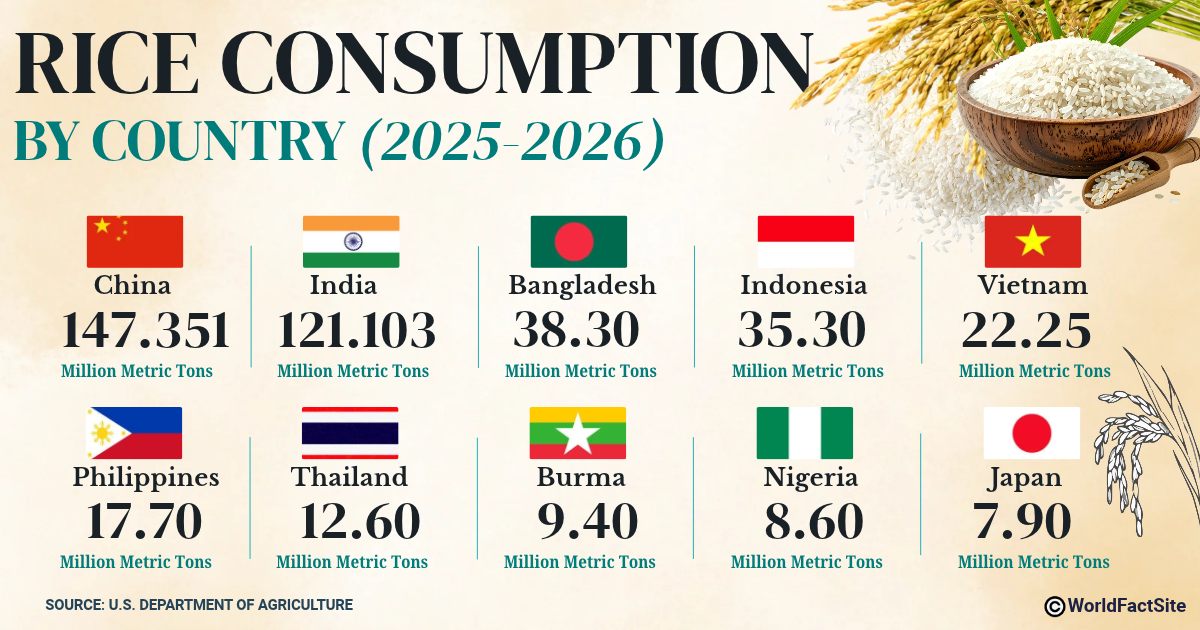
Domestic rice consumption by major consumer nations in MY 2025-26 (USDA)
| Country | Domestic Consumption of Rice (Metric Tons) |
|---|---|
 China | 147.351 Million |
 India | 121.103 Million |
 Bangladesh | 38.3 Million |
 Indonesia | 35.3 Million |
 Vietnam | 22.25 Million |
 Philippines | 17.7 Million |
 Thailand | 12.6 Million |
 Burma | 9.4 Million |
 Nigeria | 8.6 Million |
 Japan | 7.9 Million |
1. China
The second-largest producer of rice is also the largest consumer of the cereal crop. In MY 2025/2026, China's consumption reached 147.351 million metric tons, up 2.394 million metric tons from 144.957 million metric tons the previous year.
- On-farm and seed consumption: USDA credited the increase in total domestic consumption to rising planting area of high-quality rice, improved yields, higher milling recovery rates, and better grain quality.
- Animal feed: Old stock and broken rice are used in the animal feed market, but their use depends on market and government auction prices. Growth in rice consumption is fueled by its use as animal feed.
- Industrial use: Government reserves of aged rice are supplied for ethanol production. During mid-June 2026, nearly 1.8 million metric tons of rice were sold for combined feed and ethanol uses.
2. India
In MY 2025/2026, India’s rice consumption was 121.103 million metric tons. Rice is a major staple cereal crop in India, feeding more than 70% (two-thirds) of the nation’s population. But rice consumption dropped by about 254,000 metric tons from the previous year’s consumption of 121.357 million metric tons. USDA attributes this drop to the government providing rice free of cost, along with a growing economy and health consciousness among the middle class.
- On-farm and seed consumption: More than 90% of Indian small landholder rice farmers (own less than 2 hectares of land) use almost half of their produce for food and cultivation.
- Animal feed: Broken rice and de-oiled rice bran are used as commercial feed in poultry, the dairy sector, and aquaculture.
- Industrial use: Broken and damaged rice, along with surplus government rice, is used to produce ethanol for fuel blending. In 2025-26, the government allocated 5.2 million metric tons of rice for ethanol production.
3. Bangladesh
Third on the list of countries that lead in rice consumption globally is Bangladesh, with its annual consumption recorded at 38.3 million metric tons in MY 2025/26. It was about 300,000 metric tons higher than the previous year (38 million metric tons). Most people opt for parboiled rice (prepared by partially boiling unhusked rice before milling) for daily consumption, though some regional populations also prefer non-parboiled rice. Puffed rice also makes up a noticeable share and is eaten as a snack.
- On-farm and seed consumption: Farmers save and use about 0.5 million metric tons of inbred rice varieties for cultivation.
- Animal feed: Around 3.5 million metric tons of rice are used annually for household-level animal feeding, as per a study by the Food Planning and Monitoring Unit (FPMU) of Bangladesh’s Ministry of Food.
- Industrial use: Rice milling by-products, bran, and rice polish are used in commercial feed production.
4. Indonesia
In terms of total rice consumption by country, Indonesia comes fourth, with total domestic consumption of 35.3 million metric tons in MY 2025/26. The annual rice consumption of the archipelago nation fell by 0.2 million metric tons from last year’s consumption of 35.5 million metric tons. A USDA report linked the decline to increasingly diverse diets, with a growing preference for flour-based foods, and aid allocations.
- On-farm and seed consumption: To support paddy cultivation in 2025/26, the Ministry of Agriculture (MOA) allocated funds for subsidized paddy seeds covering 2.6 million hectares.
- Animal feed: Rice bran is used in varying amounts in animal feed, although the exact amount is undetermined.
- Industrial use: Traditionally, imported broken rice and broken glutinous rice (both with whole-grain levels <15%) were used in the rice flour industry. However, the Indonesian government banned imports in 2025-26 due to high domestic production.
5. Vietnam
Vietnam has the next-highest rice consumption by country in MY 2025/26, at 22.25 million metric tons. This represents a marginal decline of 0.05 million metric tons from the previous year’s consumption of 22.30 million metric tons. The USDA report linked this decline to a fast-paced economy and rising incomes. Consumers are replacing rice in their diets with protein, fruits, and other processed foods.
- On-farm and seed consumption: Extended heat periods, limited irrigation facilities, and other difficult conditions pushed rice farmers to choose higher-value crops like fruits and aquaculture over low-profit, high-cost rice production, ultimately reducing rice use as seed.
- Animal feed: In calendar year (CY) 2026, nearly 0.54 million metric tons of imported rice bran and broken rice were used for animal feed in Vietnam. In contrast, 1.685 million metric tons of locally produced rice were used for animal feed.
- Industrial use: Vietnam imported 3.5 million metric tons of milled rice equivalent (MRE) from India and Cambodia in 2025-26, used for both animal feed and the food processing industry.
6. Philippines
According to USDA’s country-wise rice consumption data for MY 2025-26, the annual rice consumption in the Philippines was 17.7 million metric tons. Current consumption rose by about 0.2 million metric tons from 17.5 million metric tons in the same period the previous year. Consistent demand for milled rice, especially from lower-income households, along with rising per capita consumption and population, drove the moderate rise in consumption.
- On-farm and seed consumption: Although the USDA report broadly focuses on rice consumption trends apart from on-farm and seed use, in the 4th quarter of 2025, a wetter climate increased post-harvest losses of clean and dry palay (unmilled rice), hence increasing its residual.
- Animal feed: USDA does not report rice consumption for animal feed in the Philippines.
- Industrial use: USDA does not report rice consumption for industrial use in the Philippines.
7. Thailand
Thailand surpassed its previous year’s (MY 2024/25) rice consumption of 12.5 million metric tons by 0.1 million metric tons, reaching 12.6 million metric tons in MY 2025/2026. The slight increase in consumption is due to the arrival of 33 million tourists in 2025, which overcomes any minor decrease in domestic consumption.
- On-farm and seed consumption: Off-season paddy rice planting declined during MY 2025/26, potentially signaling reduced demand for rice as seed. However, the USDA report did not estimate seed use and on-farm consumption separately.
- Animal feed: USDA reported that 3 to 4 million metric tons of broken rice were used for animal feed and the food processing industry in Thailand during MY 2025-26.
- Industrial use: Consumption of broken rice by the domestic food processing industry, such as noodle manufacturing, catering, and the hospitality sector, remained steady due to tourism expansion.
8. Burma (Myanmar)
Rice is a staple food in Burma. USDA estimated the country’s annual rice consumption at 9.4 million metric tons in MY 2025-2026, about 0.2 million metric tons less than the 9.6 million metric tons consumed in MY 2024-2025. Overall consumption declined due to migration, ongoing civil conflict, and a shrinking tourism sector.
- On-farm and seed consumption: Burmese farmers grow over 200 rice varieties, broadly categorized into three types: Aemahta (high-quality long grain), Pawsan (premium-quality medium and round grain), and Ngasein (low-quality short grain).
- Animal feed: Each year, Myanmar’s livestock industry uses around 0.15-0.25 million metric tons of broken rice.
- Industrial use: Ngasein rice and broken rice are the primary preference for noodle, traditional rice snack, and spirits manufacturers.
9. Nigeria
USDA’s world rice consumption by country data reported Nigeria’s consumption at 8.6 million metric tons, about 0.3 million metric tons higher than the 8.3 million metric tons recorded in MY 2024/2025. Informal imports of rice from India and Thailand lowered domestic rice prices, contributing significantly to this rise in consumption.
- On-farm and seed consumption: USDA does not report rice consumption for on-farm and seed use in Nigeria.
- Animal feed: A few animal feed manufacturers, especially poultry feed producers, started using rice bran as an alternative to higher-priced corn, driving up rice consumption.
- Industrial use: USDA does not report rice consumption for industrial use in Nigeria.
10. Japan
Japan's rice consumption reached 7.9 million metric tons in MY 2025/26, down by 0.2 million metric tons from 8.1 million metric tons in MY 2024/25. Over the past sixty years, the nation’s table rice consumption has gradually fallen due to lower per capita consumption, driven by population decline and an increase in the elderly population.
- On-farm and seed consumption: Consumption dropped as most rice farmers are older, making rice farming tougher and pushing them to adopt other crops like wheat and barley.
- Animal feed: The dwindling use of rice as feed also contributed to the decline in consumption; along with other factors, this reduced demand.
- Industrial use: Increased exports of rice products like microwavable packaged rice and sake (rice wine) sustain the consistent demand for rice by processing industries.