
Shrimp aquaculture is a key part of the global seafood industry. It occurs across a wide range of environments, making it a rapidly growing form of aquaculture and a growth driver for several countries. These countries have contributed significantly to meeting domestic and international demand through shrimp farming.
The world’s top five shrimp-producing countries reportedly produced over 6.4 million tonnes in 2025. This article explores FAO's (Food and Agriculture Organization of the United Nations) 2025 shrimp production by country data, including commonly farmed species, major production highlights, and trends in respective markets.
Here’s the latest data on global farmed shrimp production by country:
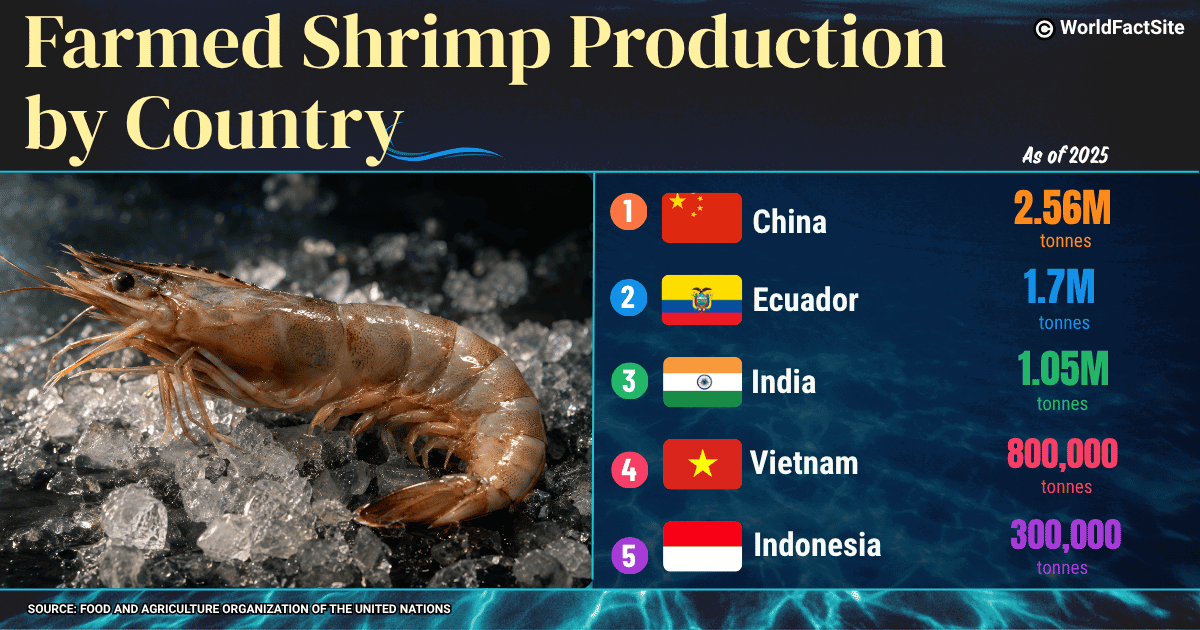
Largest producers of farmed shrimp in the world (FAO, 2025)
| Country | Total Farmed Shrimp Production (Tonnes) |
|---|---|
 China | 2.56 Million |
 Ecuador | 1.7 Million |
 India | 1.05 Million |
 Vietnam | 800,000 |
 Indonesia | 300,000 |
1. China
China's farmed shrimp aquaculture output was reported at 2.56 million tonnes in 2025. As the leading nation in global shrimp production, China mainly reared Pacific white shrimp (Penaeus vannamei), which accounted for 2.4 million tonnes. About 0.16 million tonnes were Black tiger shrimp (Penaeus monodon). Consistent output from the greenhouse shrimp farming sector drove this abundant harvest. Most output is consumed in domestic markets.
2. Ecuador
Almost all of Ecuador's 1.7 million tonnes of shrimp produced in 2025 were Pacific white shrimp. It is also the second-largest producer of this species, after China. Optimum culture conditions, low-density farming techniques, and shorter intervals between production cycles made this Latin American nation a top shrimp producer in 2025. The bulk of the nation's output is export-oriented.
3. India
India, with a total output of 1.05 million tonnes, was named one of the leading nations in global farmed shrimp aquaculture in 2025. During the first quarter, Pacific white shrimp production was relatively low. However, it makes up a major portion of the nation’s total output. India’s black tiger shrimp production reached around 60,000 tonnes by year-end. The bulk of the nation's output is export-oriented.
4. Vietnam
By the end of 2025, Vietnam’s shrimp production reached 800,000 tonnes. This bumper production, most of it Pacific white shrimp, is attributed to Vietnamese farmers adopting water-quality sensors, automated aeration, lined ponds, and improved feed management practices. The bulk of the nation's output is for domestic markets.
5. Indonesia
According to FAO, Indonesia’s total farmed shrimp output in 2025 was around 300,000 tonnes. While shrimp farming across most South and Southeast Asian countries slowed during the seasonal winter period (November-January), Indonesia's production remained relatively active during those slowdowns. The bulk of the nation's output is export-oriented.


