
On July 7 2007, the New 7 Wonders of the World Foundation announced seven iconic monuments that showcase humanity’s greatest achievements in architecture, engineering, and culture, selected through a global voting campaign.
This guide provides insights into the latest 7 wonders of the world, along with each site's country, history, and construction period.
Here are the New 7 Wonders of the World:
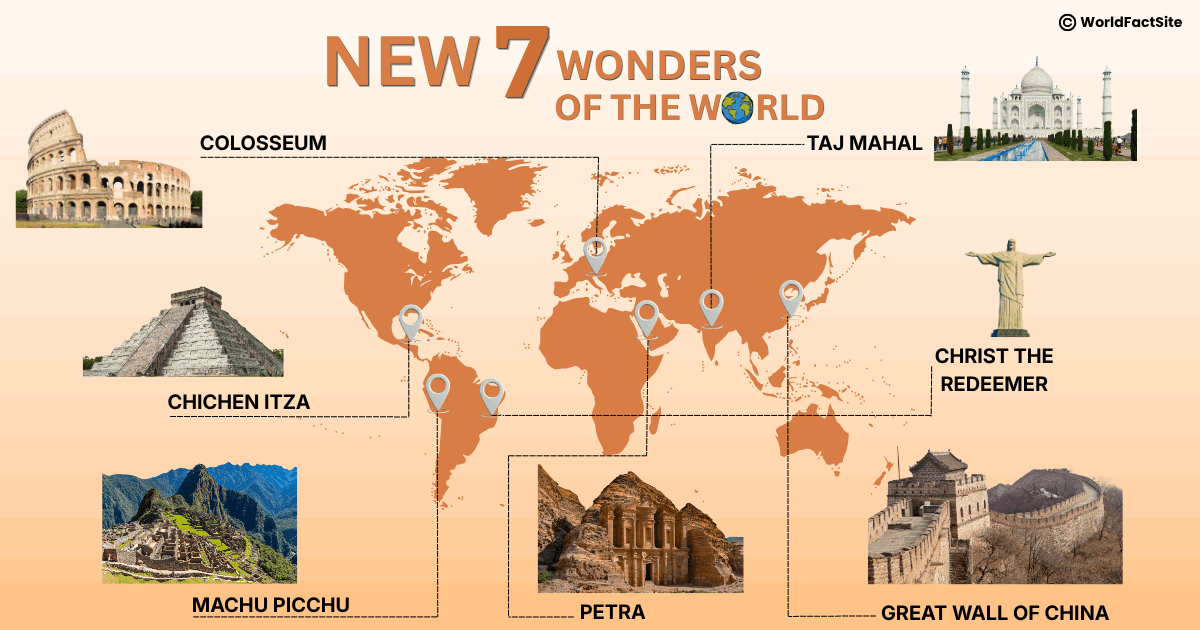
World map depicting the locations of the New 7 Wonders of the World
| Monument Name | Country | Construction Period |
|---|---|---|
| The Great Wall of China |  China | 3rd century BC to 17th century AD |
| Machu Picchu |  Peru | 15th century AD |
| Chichén Itzá |  Mexico | 6th century CE to 10th century CE |
| Petra |  Jordan | 312 BCE |
| Christ the Redeemer |  Brazil | 1922 to 1931 |
| The Colosseum |  Italy | 72 AD to 80 AD |
| Taj Mahal |  India | 1631 AD to 1653 AD |
1. The Great Wall of China
Stretching 13,171 miles (21,196 kilometers) across the Chinese landscape, from the east at Dandong to the west at Lop Lake, the Great Wall of China is one of the official New 7 Wonders of the World. It is the longest human-made wall in the world. In 1987, UNESCO recognized the Great Wall of China as a World Heritage Site.
- Construction period: 3rd Century BC to 17th Century AD
- Famous for: World's longest military defense wall and man-made structure
2. Machu Picchu
Situated 50 miles (80 kilometers) northwest of Cusco, Peru, above the valley traversed by the Urubamba River in the Machupicchu district of the Urubamba province, are the ancient ruins of Machu Picchu. Listed among the New 7 Wonders of the World, Machu Picchu lies at an elevation of 7,874 feet (2,400 meters) within the Peruvian Andes. It became a UNESCO World Heritage Site in 1983.
- Construction period: 15th century AD
- Famous for: Inca architecture, Inti Watana, Temple of the Sun, The Room of Three Windows
3. Chichén Itzá
The pre-Hispanic city of Chichén Itzá is located in the northern region of the Mexican state of Yucatán. It is about 75 miles (120 kilometers) east-southeast of the state’s capital, Merida. The archaeological site of Chichén Itzá is one of the New 7 Wonders of the World. In 1988, UNESCO recognized its cultural importance and declared it a World Heritage Site.
- Construction period: 6th Century CE to 12th Century CE
- Famous for: Mesoamerican architecture, the Temple of Kukulkan, El Caracol
4. Petra
Nestled in southern Jordan’s Ma’an Governorate stands the breathtaking ancient city of Petra. UNESCO declared Petra a World Heritage Site in 1985. Because of its many rose-colored sandstones, the city is called the Rose City. Petra has exceptional examples of ancient Nabataean rock-cut masonry, Hellenistic architecture, and an efficient water conservation system.
- Construction period: 312 BCE
- Famous for: Rock-cut architecture and water conduit system
5. Christ the Redeemer
Positioned at an elevation of 2,300 feet (700 meters) on Corcovado Mountain, within the Tijuca Forest National Park of Rio de Janeiro, Brazil, is Christ the Redeemer, one of the New 7 Wonders of the World. It is a 98-foot (30-meter) ginormous statue of Jesus Christ made from reinforced concrete and covered with triangular soapstone tiles. It stands on a 26-foot (8-meter) tall pedestal with arms outstretched 92 feet (28 meters). In 2012, it gained UNESCO protection as a key feature of Rio de Janeiro’s World Heritage-designated landscapes.
- Construction period: 1922 to 1931
- Famous for: World’s largest Art Deco-style sculpture
6. The Colosseum
The Colosseum Amphitheater, located at the center of Rome, Italy, is another of the New 7 Wonders of the World. It is oval-shaped and covers 5 acres (2 hectares). With a maximum length of 620 feet (189 meters) and a maximum width of 511 feet (156 meters), the structure can host 87,000 spectators. In 1980, UNESCO declared it a World Cultural Heritage Site.
- Construction period: 72 AD to 80 AD
- Famous for: Largest amphitheater in the world
7. Taj Mahal
The Taj Mahal was declared the Winner of the New 7 Wonders of the World (2000-2007) initiative. Located in the Agra District of the Indian state of Uttar Pradesh, it is a white marble mausoleum situated within a 42-acre (17 hectares) complex. Castellated walls secure it on three sides, and the River Yamuna on the fourth. Mughal Emperor Shah Jahan I commissioned the monument as a memorial to his beloved late wife, Mumtaz Mahal. The Taj Mahal was recognized as a UNESCO World Heritage Site in 1983.
- Construction period: 1631 AD to 1653 AD.
- Famous for: Crown jewel of Mughal architecture
