
Crude oil continues to drive the global economy in the 21st century. It is what fueled the industrialization and modernization of the world during the last hundred years.
Millions of years of geological evolution determined which countries hold the world's largest share of oil reserves deep underground.
This article lists the top 10 countries with the largest proven oil reserves, defined as the amount of crude oil that can be extracted under current operating and economic conditions with reasonable certainty.
Here are the top 10 countries that hold the world’s largest oil reserves:
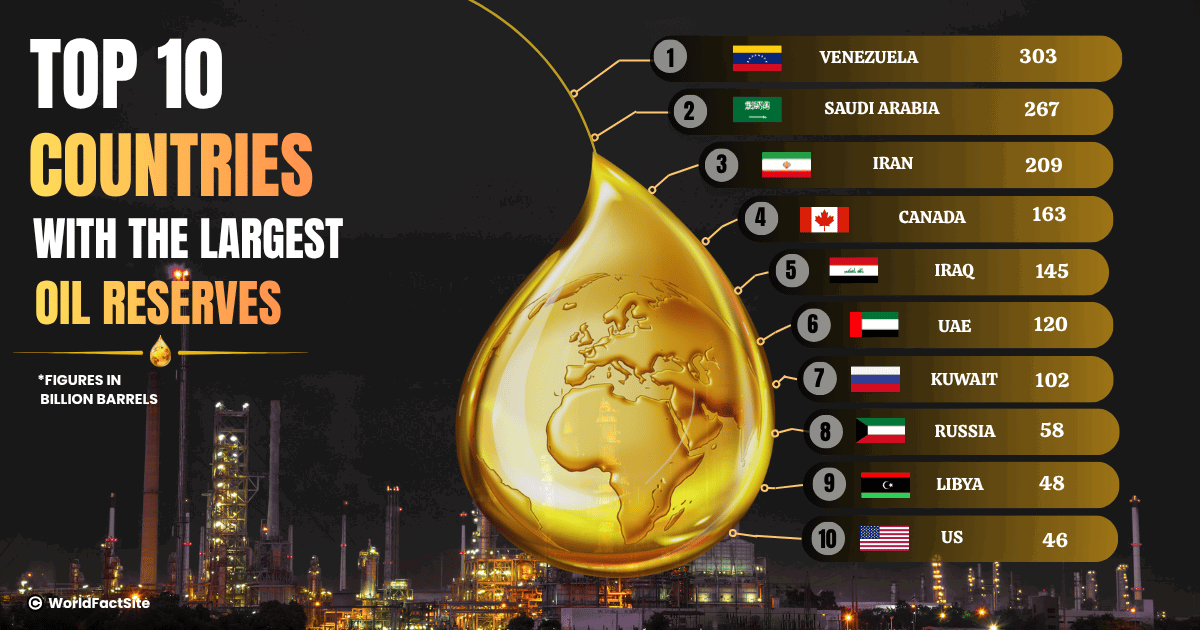
10 countries with the world’s largest oil reserves in billion barrels
| Rank | Country | Proven Oil Reserves (billion barrels) |
|---|---|---|
| 1 |  Venezuela | 303 |
| 2 |  Saudi Arabia | 267 |
| 3 |  Iran | 209 |
| 4 |  Canada | 163 |
| 5 |  Iraq | 145 |
| 6 |  UAE | 120 |
| 7 |  Kuwait | 102 |
| 8 |  Russia | 58 |
| 9 |  Libya | 48 |
| 10 |  US | 46 |
1. Venezuela
The South American country holds the largest oil reserve on Earth. In 2023, the Energy Information Administration (EIA) estimated that Venezuela’s proven crude oil reserves were around 303 billion barrels. The Orinoco Belt, which spans east to west across the middle of the country, is a principal onshore oil reserve. Venezuela’s extra-heavy crude oil requires technical prowess and billions of dollars for extraction, both of which are constrained by international sanctions, political instability, and limited foreign direct investment.
As of August 2026, nearly 65 billion barrels of Venezuela's proven oil reserves are now under US control. According to Trump, this deal "doubles America's oil reserves." The American President hopes to reduce oil prices through this takeover, which will be a challenge given Venezuela's current dilapidated infrastructure.
2. Saudi Arabia
According to Wikipedia, Saudi Arabia’s proven crude oil reserves stand at 267 billion barrels as of 2023, trailing just behind Venezuela. According to the EIA, the country holds 17% of the world’s total oil reserves. Most crude oil produced by Saudi Arabia has high sulfur content (>1%), making it sour crude; it is relatively hazardous and requires an expensive refining process. The Ghawar field is the largest and most important onshore oil field, and Safaniya is the largest offshore oil field.
3. Iran
Iran holds approximately 209 billion barrels of proven oil reserves (Wikipedia, 2023). According to the EIA, about 86% of its oil reserves are concentrated in the southwestern province of Khuzestan, including the onshore fields of Gachasaran, Marun, and Ahvaz. These fields produce medium-heavy crude oil with 2.24% sulfur. Iran's Ahwaz, Karanj, and Aghajari fields produce a relatively light type, with a sulfur content of 1.46%. Iran also has some offshore fields in the Persian Gulf.
4. Canada
Canada ranks fourth among the top 10 countries with the largest oil reserves in the world. Of Canada's 2024 total proven oil reserves of ~163 billion barrels, nearly 97% are bitumen (oil sands), largely concentrated in Alberta, with major deposits in the Athabasca, Peace River, and Cold Lake regions. The remaining 3% consists of heavy, medium, and light crude oil.
5. Iraq
Iraq has the world's fifth-largest oil reserves, estimated at about 145 billion barrels (EIA, 2023), which are controlled by both the Federal Government of Iraq and the Kurdistan Regional Government. Iranian oil accounts for nearly 9% of global reserves. Aside from a few reserves in central Iraq, most oil fields are in the Shiite south or the Kurdish north. The country's reserves produce medium and heavy crude oil.
6. United Arab Emirates
The United Arab Emirates (UAE) ranks sixth on the list of countries with the world's largest oil reserves. EIA's 2025 estimate for the UAE’s proved crude oil reserves is around 120 billion barrels. Depending on the extracted oilfields, a wide range of crude oil, from heavy to light, is produced. Upper Zakum, Lower Zakum, Bab, Bu Hasa, Dabbiya, and Asab are some of the UAE’s key onshore and offshore oil fields.
7. Kuwait
Next on the list of countries with the most oil reserves in the world is Kuwait. The proved crude oil reserves (as of the end of 2022, EIA) are estimated at 102 billion barrels, accounting for a 6% share of the world’s total oil reserves. The Burgan field, a significant oil extraction site, produces medium-sour crude oil. The Jurassic oil and natural gas field produces super-light oil, whereas Umm Naqa and Ratqa fields produce heavy-grade crude oil.
8. Russia
Russia’s proved oil reserves stand at approximately 58 billion barrels (as of early 2024, EIA). Among eight different grades of crude oil produced by Russian oil fields, a medium-sour grade called Urals (1.3-1.5% sulfur content), found in Western Siberia and the Volga-Ural region, forms a major part of the country’s oil exports.
9. Libya
Libya has Africa’s largest oil reserves and the world’s ninth-largest. As of early 2024 (EIA), Libya has around 48 billion barrels of proved oil reserves. It produces high-quality light, sweet crude oil; despite this, a large quantity of oil remains untapped due to limited exploration amidst civil unrest. The Sirte Basin and the Murzuq Basin are some of the nation’s most important onshore sites.
10. United States
The United States boasts the world's 10th-largest oil reserves, holding nearly 46 billion barrels (EIA, 2024). The country’s oil fields mostly produce light, sweet crude oil known for low sulfur content. The US's most crucial oil fields are in New Mexico, Texas, North Dakota, California, Louisiana, and the Federal Offshore Gulf of Mexico.
