
Due to the 2026 ‘Super El Niño,’ increasingly unbearable heat worldwide is causing a sudden surge in air conditioning use across the globe. There are several additional factors that determine air conditioner use among a country’s natives, including climate and household income.
This article lists the percentage of homes with air conditioning usage by country according to the latest International Energy Agency (IEA) data.
Here's the percentage of homes with air conditioning usage by country
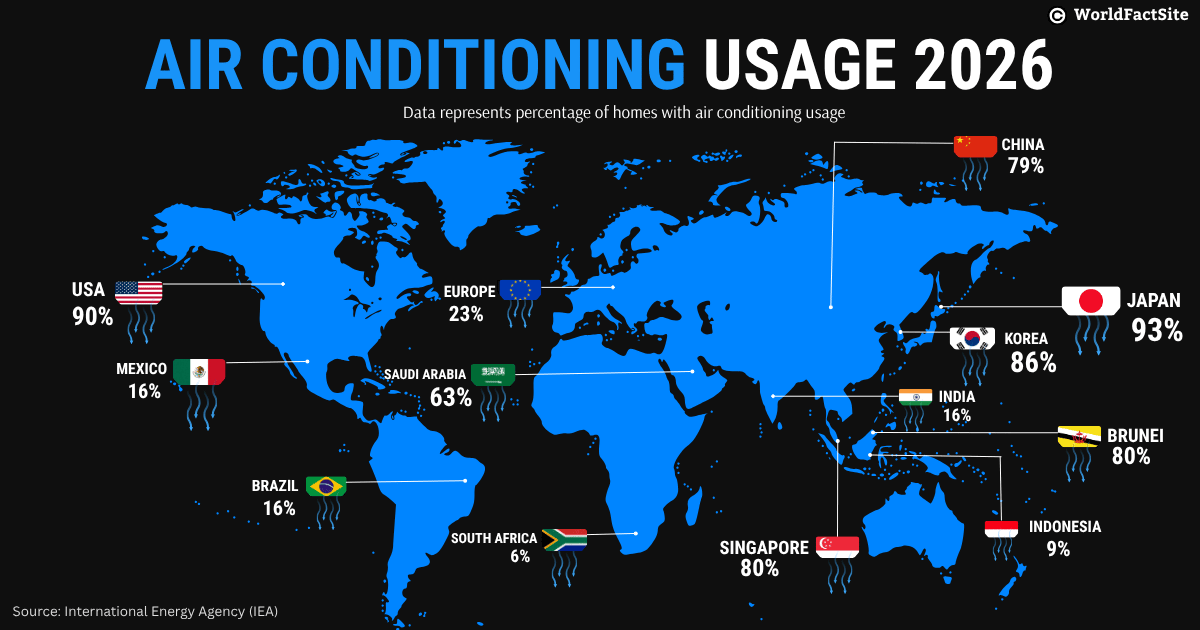
World map depicting the percentage of homes with air conditioning usage by country in 2026 as per IEA data
| Rank | Country | Percentage of homes with air conditioning |
|---|---|---|
| 1 | Japan | 93% |
| 2 | United States | 90% |
| 3 | Korea | 86% |
| 4 | Singapore | 80% |
| 5 | Brunei | 80% |
| 6 | China | 79% |
| 7 | Saudi Arabia | 63% |
| 8 | Europe | 23% |
| 9 | Brazil | 16% |
| 10 | Mexico | 16% |
| 11 | India | 16% |
| 12 | Indonesia | 9% |
| 13 | South Africa | 6% |
1. Japan
The island country in East Asia ranks first in worldwide air conditioning usage. According to the IEA 2025 report, the hot, muggy heat during intense summers causes around 93% of Japanese households to have air conditioners. Because of the extreme heat, the use of air conditioning has become more of a necessity than a luxury in Japan.
Most AC units in Japan also function as heaters during winter. However, people prefer traditional heating methods such as fan heaters and oil stoves to keep their electricity bills low. Only 23% of residents use air conditioners during winter.
2. United States
Around 90% of homes in the United States have air conditioning. The country adopted space cooling a very long time ago and developed an efficient central cooling system, resulting in a high penetration rate in the residential sector. The hot Southern states, in particular, account for most air conditioning usage and therefore high electricity bills.
3. Korea
Korea has also witnessed an unexpected increase in air conditioning use, estimated at 86% according to the IEA. The manufacturers attribute the spike in domestic air conditioner usage to the availability of more efficient models and hotter summers.
However, Reuters has reported that, as of June 2026, 98% of South Korean homes own air conditioning units. Because South Korea is a high-income nation, most people can afford to purchase and use AC units.
4. Singapore
Based on residential air conditioner penetration rates, the IEA noted remarkably high household air conditioner ownership in Singapore at nearly 80%.
The nation is part of a Southeast Asian alliance called ASEAN, where almost 30% of households have air conditioners. The IEA attributes the difference in usage between the country and the region to stark disparities in residential AC availability in other countries, such as Myanmar, at about 5%. This disparity reflects differences in income, living standards, and population across countries.
5. Brunei
Brunei Darussalam closely follows Singapore, with about 80% of households having air conditioners. As an ASEAN nation near the equator, Brunei has a hot, humid climate.
The climate, along with widespread electrification and low tariffs driven by abundant crude oil and other natural resources, contributed to the rise in air-conditioning use.
6. China
Nearly 79% of Chinese homes are equipped with air conditioners, according to IEA 2025 data. China is the largest electricity producer and consumer in the Asia-Pacific region, a major contributor to high air-conditioning use in its residential areas.
Most families own more than one AC unit, a majority of which are mini-split systems rather than central cooling systems, as is prevalent in America. Regionally, air conditioning use is highest in the hot, humid Southern Chinese provinces of Guangzhou and Fujian.
7. Saudi Arabia
Saudi Arabia’s weather is generally hot for much of the year. Here, in summer, temperatures can reach an unforgiving 40°C to 45°C (104°F to 113°F), which is why 63% of homes in Saudi Arabia have air conditioning units. Other contributing factors include subsidized electricity tariffs and high individual incomes.
8. Europe
The effects of rising global temperatures are evident in European countries facing the punishing heatwave in 2026. Remarkably, only 23% of European homes have air conditioning (IEA, 2025), making them ill-equipped to face the crisis. Amongst European countries, Italy leads with around 50% of homes equipped with air conditioners for summer. In contrast, only 3% of homes in the United Kingdom use air conditioning according to EDRC (Energy Demand Research Centre).
Despite historical resistance to widespread air conditioning use in Europe due to adverse environmental impacts, the number of units is predicted to rise sharply amid the heatwave.
9. Brazil
In Brazil, 16% of homes use air conditioning, according to national statistics from the IEA. However, the country is known for its wide economic disparity. In the poorest regions of Piauí and Alagoas, fewer than 1% of homes have air conditioning, while that number rises to 25% in the richest areas of Rio de Janeiro and Santa Catarina.
10. Mexico
The percentage of homes with air conditioning usage in Mexico is about 16%, similar to that in Brazil. High economic inequality, despite the country's warm climate, is responsible for the low adoption rate of AC units in Brazilian households.
11. India
In a country of over a billion people, air conditioning is still a luxury. At present, nearly 16% of Indian households can afford that luxury. Record-breaking summers, rising disposable incomes, and energy-efficient systems are reportedly set to drive a ninefold increase in AC ownership by 2050.
12. Indonesia
Indonesia's equatorial position results in year-round heat, high humidity, and rising average temperatures due to global warming. Even so, only 9% of Indonesian households own air conditioning units. Most homes in Indonesia are built to combat heat, with large windows, high ceilings, and perforated bricks, which allow the breeze to pass through.
However, AC adoption is still expected to rise as global temperatures increase.
13. South Africa
Despite extreme temperatures, only 6% of South African residential dwellings have air conditioning units. This low adoption rate is mainly due to the slower economic growth and severe power outages (known as “loadshedding”).
However, the use of renewable energy and the reduction in historical load shedding may increase air conditioning use, especially in hotter areas of Durban and the Northern Cape.